What is a stroke?
There are two types of stroke:
•
Ischaemic stroke: This occurs when blood flow to the brain is blocked or reduced. This is the more common form of stroke. It is further classified depending on where in the brain the blockage occurred. It is normally caused by a piece of plaque or blood clot. If the clot occurs locally in the brain then it is termed a thrombosis. If it is deemed that the blood clot has traveled from somewhere else in the body it is called an embolism. When plaque build up on the inner walls of an artery it can lead to a disease called atherosclerosis. Plaque build up can block an artery, such as in the brain or neck, and can reduce blood flow to the brain, this then leads to an Ischaemic stroke.
o
Transient Ischaemic attack (TIA): sometimes known as a “mini stroke”, this is when the blockage breaks up before there is any damage to the brain.
•
Hemorrhagic stroke: This occurs when there is sudden bleeding in the brain. This occurs when an artery in or on top of the brain breaks open. The blood can cause the brain to swell which raises the pressure in the brain and can damage brain cells.
o
Intracranial Haemorrhage: bleeding within the skull
o
Subarachnoid Haemorrahage: bleeding between the brain and the membrane that surrounds it
A stroke is a medical emergency and both of these types of stroke can cause lasting damage to the brain, long term disability, and in some cases death.
Each part of the brain is responsible for different functions and thought processes. The types of symptoms and the effect of the damage to the brain all depends on where the damage occurred.
Complications that can follow a stroke include, but are not limited to:
•
Loss of bladder or bowel control
•
Muscle weakness, inability or difficulty moving one side of the body, both sides of the body, or specific limbs
•
Problems with processing and interpreting language
•
Problems with thinks or with memory
•
Loss of, or reduced vision, sound or touch
•
Problems swallowing or eating
•
Difficulty forming speech and/or intelligible language
Recovery:
It can take weeks, months or even years to recover from a stroke. Some people may recover fully whilst others have long term or lifelong disabilities.
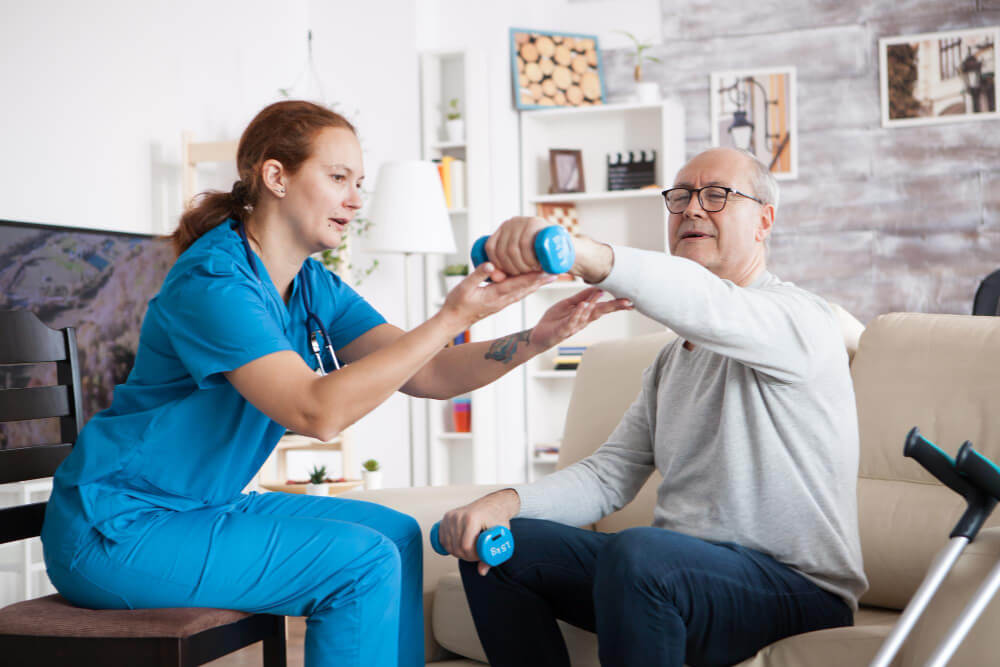
Rehabilitation and ongoing healthcare is an important part of stroke recovery and will look different for each individual depending on what areas are affected. Rehabilitation may include working with speech, physical and occupational therapists.
Physiotherapists have an important role to play in stroke rehab and are generally relevant throughout the entirety of your stroke recovery journey. They work with stroke survivors on addressing, maintaining and improving strength and conditioning, muscle tone, coordination, gait and balance to enhance a patient’s capacity for activities of daily living and quality of life. They work with patients and support workers on safe, effective and efficient transfers, as necessary, to optimise a pt’s mobility at home and in the community.
Occupational therapists help to alter the environment a patient lives and works in to maximize a patient’s safety post stroke and to assist in mobilizing around the home and in the community. They can identify helpful assistive devices and make sure they are in place for ease of access. Occupational therapists work on optimizing the function and fine motor control of the upper limbs, as appropriate, and can help with finding new ways to perform activities of daily living.
Speech pathologists work closely with patients post stroke who may be struggling with eating, swallowing, producing and/or understanding verbal, non verbal and/or written communication.
They can help improve a patient’s engagement with family, friends, support workers and healthcare by improving communication skills and by working with the patient on new ways to communicate as necessary.
REFERENCES:
National Heart Lung and Blood Institute (2023). Stroke – Recovery. https://www.nhlbi.nih.gov/health/stroke/recovery [accessed 28 May, 2024]
National Heart Lung and Blood Institute (2023). Causes and Risk Factors. https://www.nhlbi.nih.gov/health/stroke/causes [accessed 28 May, 2024]
National Heart Lung and Blood Institute (2023). Symptoms. https://www.nhlbi.nih.gov/health/stroke/symptoms [accessed 28 May, 2024]
National Heart Lung and Blood Institute (2023). Symptoms.
https://www.nhlbi.nih.gov/health/stroke [accessed 28 May, 2024]